
SGx2026 Panel Descriptions
Launch Leaders: Women Driving Innovation in Space
Panel Description:The conversation will focus on the leadership journeys of women in the sector, the innovations driving the industry forward, and the opportunities ahead as the global space economy continues to grow. We’re assembling a group of leaders who can share perspectives on navigating the industry, advancing innovation, and helping inspire the next generation of space professionals.
Speakers

Lauren Smith is a senior program manager for the Logistics & Servicing operating unit Space Superiority division of Northrop Grumman Space Systems. In this role, Smith leads the portfolio of programs that advance the future of in-space refueling, including Solitaire, Opis, GAS-T, and Elixir.
Smith has served in multiple, diverse air and space roles across her career at Northrop Grumman. She was the operations manager for a portfolio of 13 ground and data processing programs as well as the chair of the company’s first-ever Systems and Software Engineering Symposium. Smith was previously the mechanical test engineering manager for the James Webb Space Telescope (JWST) and a member of the JWST integration and test senior staff as the lead for non-explosive actuators and deployments. As a program manager in Resilience and Rapid Prototyping, NG Next, and Advanced Unmanned Systems, Smith has executed numerous programs and contributed to several strategic captures.
Before joining Northrop Grumman, Smith worked at NASA Glenn Research Center in the Simulated Lunar Operations Lab. She also conducted her thesis work at Glenn, specializing in mechanisms and robotics. This work contributed to being named one of Aviation Week’s Twenty20s.
Smith currently serves on both the Space Foundation and Case Alumni Association board of directors, as well as the industry advisory board for her alma mater’s mechanical and aerospace engineering departments. She is a member of the AIAA ASCEND Guiding Coalition, serves on two committees for the International Astronautical Foundation, and has held numerous leadership roles for the Space Generation Advisory Council. Smith has also been recognized as a Future Space Leader Grant and National Academy of Engineering Frontiers of Engineering award winner.
Smith holds a bachelor’s degree in aerospace engineering, bachelor’s and master’s degrees in mechanical engineering, and a minor in political science from Case Western Reserve University.
Northrop Grumman is a technology company, focused on global security and human discovery. Our pioneering solutions equip our customers with capabilities they need to connect, advance and protect the U.S. and its allies. Driven by a shared purpose to solve our customers’ toughest problems, our 90,000 employees define possible every day.
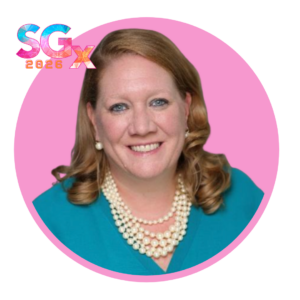
Deirdre M. Walsh is responsible for strategy and government affairs for ARKA Group.
Before joining ARKA, Walsh served as vice president of Strategic Operations for Ball Aerospace & Technologies and led the creation of government relations strategies.
Previously, she served as the first chief operating officer for the Office of the Director of National Intelligence (ODNI). From 2014 to 2018, she was director of legislative affairs for ODNI, where she managed ODNI’s interaction with Congress. Earlier she was deputy director of Congressional and Public Affairs at the National Reconnaissance Office. Walsh was appointed to the Senior National Intelligence Service in 2013 and received the Distinguished Presidential Rank Award.
She holds a Master of Arts in legislative affairs from the George Washington University and a Bachelor of Science in international studies from the University of Scranton, Pennsylvania

Most recently, she served as NASA’s Associate Administrator for Technology, Policy, and Strategy, where she advised agency leadership, the White House, and interagency partners on emerging technologies, economic strategy, sustained lunar presence, and space sustainability. She led a multidisciplinary team converting technical, economic, and policyl complexity into decision-grade strategy for the highest levels of government.
Before NASA, Charity spent 23 years in the Royal Canadian Air Force, including service as Canada’s first Air and Space Operations Attaché at the Canadian Embassy in Washington, DC, where she led space-to-space military engagements between Canada and allied partners. She also served as Global VP of Policy and Government Relations at Astroscale, pioneering international norms for space sustainability and orbital debris remediation.
A Senior Nonresident Fellow at the Atlantic Council’s GeoTech Center, Charity holds a B.Eng. in Mechanical Engineering from the Royal Military College of Canada and an M.S. in Space Studies from the University of North Dakota.


Scaling Access to Space: Building from Demonstration to Constellation
Panel Description: As SmallSat operators move from initial missions to full constellation deployment, scaling access to space is a strategic challenge: balancing competing priorities of timeline, orbit, and cost. This panel brings together emerging constellation builders to discuss how they are unlocking access to orbit across launch providers, orbits, and geographies. Panelists will share perspectives on building scalable launch strategies and enabling sustained growth in orb
Speakers

Jungkyu Lee serves as the Chief Commercial Officer at Nara Space, where he leverages nearly two decades of expertise in space science and satellite
engineering to drive the company’s commercial strategy and global expansion.A recognized expert in small satellite systems, Jungkyu has been engaged in high-profile international missions, including ESA’sSolar Orbiter and the Korea Pathfinder Lunar Orbiter . Before stepping into his commercial leadership role, he served as the Director of Systems Development for Nara Space’sObserver-1 CubeSat, where he played a pivotal role in engineering the company’s next-
generation platforms and the Narsha methane-monitoring constellation.
Jungkyu holds a Ph.D. in Space Science from Kyung Hee University, with a research focus on magnetic anomalies and CubeSat technology. This deep technical
foundation allows him to translate complex aerospace capabilities into actionable business solutions for a rapidly evolving global market. Beyond his executive responsibilities, Jungkyu is a dedicated advocate for space education. He is a frequent speaker and public outreach leader, committed to inspiring the next generation of space professionals and fostering a collaborative global space community.

Ms. Paula Trimble is the Vice President of Government Affairs and Strategy at Muon Space, where she drives strategic relationships and advocacy for the company’s mission-customized space systems, including the wildfire monitoring FireSat constellation. Paula brings more than two decades of experience in defense and aerospace policy, acquisition, and federal relations to Muon, most recently leading the Space Development Agency’s legislative, interagency, and small business initiatives at the U.S. Department of Defense (DoD). There she crafted policy solutions to enable speed of acquisition and capability delivery.
A passion for innovation and disruption has guided Paula’s career at the intersection of policy and technology. She started her career in Washington, DC as a reporter at Space News and Federal Computer Week, then served in commercial space offices at the Department of Commerce and the Federal Aviation
Administration. She later led prototyping efforts at the DoD’s Rapid Reaction Technology Office and established the National Security practice at Lewis-Burke Associates LLC. Paula holds leadership positions at the Space Force Association, Women in Aerospace, the Gerald R. Ford Prize for Reporting on National Defense, The Holiday Project, and the Information Professionals Association. Paula earned a B.A. in Journalism from Penn State University and is a CSIS Strategy and Statecraft fellow.

Raleigh Wooldridge is the Director of Strategic Programs at Exolaunch, where he supports the senior leadership team on operational and strategic initiatives. He is a graduate of Northwestern University’s MMM program, earning an MBA from the Kellogg School of Management and an MS in Design Innovation from the McCormick School of Engineering.
His background includes a range of roles across the space industry including corporate development at Blue Origin, strategy and government affairs at Firefly Aerospace, and aerospace strategy consulting at Renaissance Strategic Advisors. Raleigh participates actively in the space industry as Treasurer of SGAC and via other young professional organisations including the Matthew Isakowitz Space Scholars and IAF’s IPMC Young Professionals Leadership Development Programme. He holds a bachelor’s degree in Mechanical Engineering through the Engineering Honors Program from the University of Texas at Austin.
Keynote Speakers
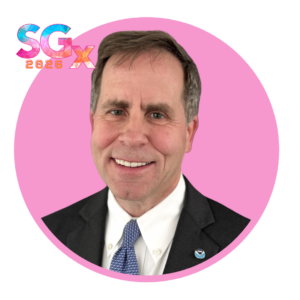
Timothy Walsh is Acting Deputy Assistant Administrator for Systems for the National Environmental Satellite, Data, and Services (NESDIS). Tim has more than 29 years of experience in supporting NOAA satellite programs. He has extensive experience leading teams large and small, and he served as the Office of Low Earth Orbit Observations (LEO) director from 2022 to 2026.
Tim joined the Senior Executive Service as deputy director of NOAA’s Office of Satellite and Product Operations (OSPO) in January 2021. Prior to his time at OSPO, Tim supported the JPSS program as deputy director, where he supported preparations for the upcoming JPSS-2 mission. Tim also served in a number of roles in the Geostationary Operational Environmental Satellites (GOES)-R Series program, including acting program director for the GOES-17 launch campaign in March 2018 and as the deputy project manager for the GOES-R Flight Project. In the flight project, Tim supported the development, integration and test, and launch and checkout of the GOES-R instrument payloads and spacecraft.
Upon first joining NOAA, Tim worked in the NOAA Satellite Operations Control Center (SOCC) as engineering branch chief, supporting operations for the GOES and Polar Operational Environmental Satellite (POES) constellations and helping transfer operations of the Defense Meteorological Satellite Program (DMSP) constellation from the U.S. Air Force to NOAA. Later, Tim became manager of the SOCC, where he led NOAA flight operations for the GOES, POES and DMSP satellites.
Before joining NOAA in 1996, Tim supported a number of NASA missions, including the launch and check out of the GOES-8 and GOES-9 spacecraft as a member of the GOES Mission Operations Support Team. He also supported the development of multiple projects for air traffic and fire-control radar systems, electronic warfare and strategic communications systems.
Tim received a Bachelor of Science degree in electrical engineering from Duke University and a Master of Science degree in electrical engineering from Johns Hopkins University. He has received Department of Commerce/NOAA Gold, Silver and Bronze Medals and a NASA Outstanding Leadership Medal for his support of NOAA satellite programs.
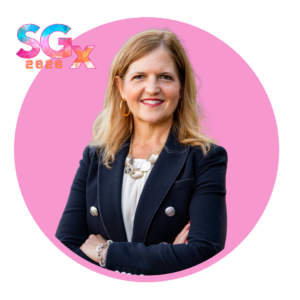
Debra Facktor is the Head of U.S. Space Systems for Airbus U.S.Space & Defense, Inc. She leads the Airbus U.S. Space line of business with a focus on small satellites produced for commercial and government customers at the company’s manufacturing facility in Merritt Island, Florida, and on space exploration activities in the U.S. Debra sits on the board of directors for Starlab Space LLC, a joint venture between Voyager and Airbus to build and operate a next- generation commercial space station. She also served on the board of the Airbus OneWeb Satellites joint venture prior to its recent acquisition
by Airbus U.S.
Prior to joining Airbus U.S., Debra was Vice President and General Manager of Strategic Operations for Ball Aerospace, leading the company’s Washington D.C. operations, strategic development, and marketing and communications. Her extensive business experience includes serving as President and Owner of AirLaunch LLC, and as Vice President of Business Development and Strategic Planning for Kistler Aerospace Corporation. She also served as an industry professor at Steven Institute of Technology School of Systems and Enterprises and as Director of Strategic Programs for the Systems Engineering Research Center (SERC). Earlier in her career, Debra was Chief of Moscow Operations for ANSER’s Center for International Aerospace Cooperation.
Debra is actively engaged as an advisor and mentor in the aerospace community and is a fellow of the American Institute of Aeronautics and Astronautics (AIAA). She sits on the University of Michigan Aerospace Engineering Industrial Advisory Board and is Chair of SSPI-WISE (Space & Satellite Professionals International – Women in Space Engagement), former chair of the Board of Women in Aerospace (WIA), and former treasurer of the Future Space Leaders Foundation. She is also a fellow of the American Astronautical Society (AAS), an academician of the International Academy of Astronautics (IAA), and a member of Chief. Debra received her bachelor’s and master’s degrees in aerospace engineering from the University of Michigan and is an alumna of the International Space University summer session program in Strasbourg, France.

Dr. Needham is a program scientist in the NASA Science Mission Directorate’s Exploration Science Strategy and Integration Office, where she works to set science strategy for integration into human exploration endeavors on the Moon and Mars. Dr. Needham serves as the Moon to Mars Science Strategy Lead, coordinating across divisions within SMD, with other NASA directorates, and with international partners to ensure upcoming robotic and crewed missions to the Moon are equipped to address high priority science objectives that have been championed by the science community. Most recently, Dr. Needham served as the Volcanic and Tectonics Science Theme Lead for Artemis II Lunar Observation Campaign, supporting science operations from inside NASA Johnson Space Center’s Mission Control in support of the first crewed mission around the Moon in over five decades.
Originally from Houston, Texas, Dr. Needham (née Hurwitz) earned her BA in Geology from Pomona College in 2007, her MS in Geosciences from Brown University in 2009, and her PhD in Geosciences from Brown University in 2012, with her dissertation investigating the formation and distribution of lava channels on planetary surfaces in the inner Solar System. After earning her PhD, Dr. Needham completed two postdoctoral fellowships: first, in 2012 at the Lunar and Planetary Institute in Houston, Texas, where she investigated the composition and distribution of the South Pole-Aitken impact melt sea, and second, in 2015 at Goddard Space Flight Center in Greenbelt, Maryland, where she continued her investigation of lava flow emplacement processes on the Moon and Mars through field work investigations in analog sites in Hawaii, Iceland, and New Mexico. Before moving to HQ in 2020, Dr. Needham joined NASA in 2016 as a research scientist in the Heliophysics and Planetary Science Group (ST-13) at Marshall Space Flight Center, where she continued her research of volcanic eruptions, in particular identifying volcanic eruptions as a potential source for polar volatiles identified on the Moon. While at MSFC, Dr. Needham also worked with several teams of engineers to integrate science objectives and instrumentation into future habitat and lunar lander design concepts.