In an era of hyper-interconnected technologies, the way this shared, finite resource is governed directly affects communications, navigation, broadcasting, and space exploration.
Are fragmented spectrum laws putting global connectivity at risk?
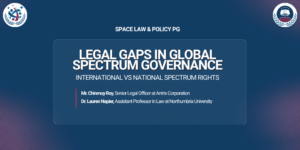
This question was at the heart of a recent webinar organized by the SLP Radiofrequency and Spectrum Research Group, co-led by Nihan Ucer Yalcin and Lise Faliu.
The event brought together international experts to discuss one of the most pressing challenges in space governance: the regulation of the radiofrequency (RF) spectrum.
The session featured insightful contributions from Dr. Lauren Napier of Northumbria University and Mr. Chinmoy Roy, Senior Legal Officer at Antrix Corporation, the commercial arm of the Indian Space Research Organisation (ISRO). Both explored the legal, technical, and policy dimensions of spectrum governance in an increasingly crowded orbital environment.
Setting the Stage: Understanding Spectrum Governance
Often referred to as the “invisible backbone of global connectivity” the RF spectrum underpins every form of modern communication, from satellite internet and mobile services to interplanetary transmissions. In an era of hyper-interconnected technologies, the way this shared, finite resource is governed directly affects communications, navigation, broadcasting, and space exploration.
Nearly every modern system depends on efficient spectrum management. Yet, this management requires a delicate balance between international coordination and national sovereignty.
The discussion emphasized the dual responsibilities of international and national regulators. The International Telecommunication Union (ITU) plays a vital role in coordinating global spectrum use and ensuring equitable access. However, growing technological demands and the rise of private space operators have made spectrum governance increasingly complex and competitive.
Dr. Lauren Napier on the legal foundations of spectrum regulation
Dr. Napier provided a detailed overview of the legal architecture of spectrum governance, focusing on the ITU’s Constitution, Convention, and Radio Regulations. These instruments are binding international treaties that evolve dynamically through amendments at the World Radiocommunication Conferences (WRCs), standing in contrast to the static nature of older space law treaties like the Outer Space Treaty of 1967.
A key point of the discussion revolved around Article 44 of the ITU Constitution. Dr. Napier reminded attendees that radio frequencies and orbital positions are limited natural resources, emphasizing the shared responsibility to use them rationally, efficiently and equitably
She also discussed the Master International Frequency Register (MIFR), namely the ITU’s central database for spectrum allocations. A register that is essential for preventing harmful interference, especially as thousands of new satellites populate Low Earth Orbit (LEO).
She further examined the milestone-based approach adopted at WRC-19, designed to curb “paper satellites”, ensuring that filings correspond to actual satellite deployment, enhancing accountability and transparency, and discouraging spectrum hoarding by mega-constellations such as Starlink and Amazon Kuiper.
From a national perspective, the UK’s Ofcom was presented as a model of effective domestic implementation. Through the Communications Act (2003) and the Wireless Telegraphy Act (2006), the UK enforces penalties for interference, translating international obligations into actionable national law. Yet, it was cautioned that cross-border enforcement remains a major challenge, particularly when private operators or dual-use systems operate beyond clear jurisdictional boundaries.
Mr. Chinmoy Roy on policy and practical challenges ahead
Complementing Dr. Napier’s legal perspective, Mr. Roy focused on the policy and operational dimensions of RF spectrum management. He began by defining the structure of the radio spectrum, explaining how frequency bands, from L and S to Ku and Ka, serve diverse purposes, spanning from satellite television and broadband to deep-space missions.
Mr. Roy emphasized that harmful interference is both a technical and diplomatic issue, which can be exploited during geopolitical conflicts. Despite the ITU’s coordinating authority, he noted, there is no global enforcement mechanism to penalize non-compliance, leading to disputes, “forum shopping”, namely situations where operators seek favorable regulatory regimes, and widening inequalities between developed and developing nations.
Mr. Roy also addressed historical inequities in spectrum allocation. Early filings under the ITU’s first-come-first-served system allowed technologically advanced nations to secure prime orbital slots, long before developing countries could participate. This legacy continues to fuel equitable access debates and disparities, particularly for emerging space nations, for instance among African countries, as well as small-scale operators, seeking fairer representation.
Further complicating matters, fragmented national licensing regimes act as barriers to global connectivity. Companies like Starlink and OneWeb must navigate numerous inconsistent regulatory regimes, each with unique fees, renewal timelines, and compliance requirements. Mr. Roy noted, this lack of harmonization creates regulatory challenges and slows the expansion of affordable internet access to remote and underserved regions.
Toward a collaborative and inclusive future
Both speakers agreed that the future of spectrum governance must be built on collaboration, transparency, and inclusivity.
Dr. Napier advocated for stronger dialogue and coordination between the ITU and the United Nations Committee on the Peaceful Uses of Outer Space (COPUOS) to bridge gaps between telecommunications law and space law. Mr. Roy echoed the need for a global adjudication mechanism to resolve interference disputes and ensure equitable access for all nations.
The discussion underscored a key message: while the international community has made progress in regulating the RF spectrum, significant work lies ahead. Modern challenges, from mega-constellations to emerging small-scall operators, demand a more adaptable and transparent system.
The event ultimately highlighted the growing importance of spectrum access for small-scale operators and the need for harmonized regulatory solutions to ensure fairness, innovation, and sustainability in the global space ecosystem, creating a level playing field for all actors in the space domain.
| Watch the recording |