
 E-SGW 2026
 About
About
 Programme
 Working Groups
 Sponsors & Partners
 Applications & Registration
 Organising Team


Programme
Select a day to view the planned sessions.
Keynotes
Keynote 1 - Dr Meganne Christian, Mission Manager & ESA Reserve Astronaut
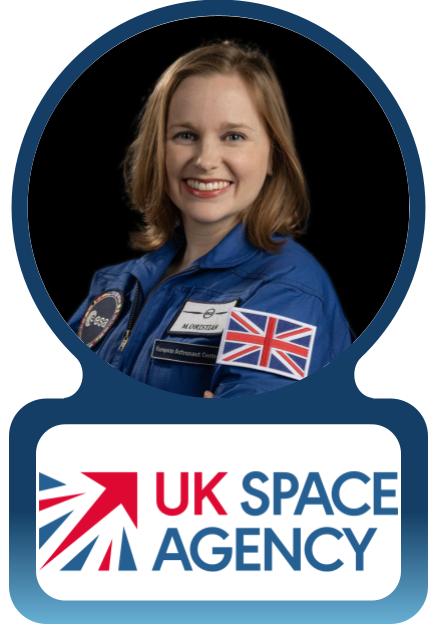
Dr Meganne Christian FRAeS is a member of the European Space Agency astronaut reserve and Mission Manager for In Space Manufacturing at the Satellite Applications Catapult. Previously, she was Senior Exploration Manager (Commercial) at the UK Space Agency. She holds a Bachelor of Engineering and a PhD in Industrial Chemistry from the University of New South Wales. From 2014 to 2023 she was a materials science researcher at the National Research Council of Italy, and participated in parabolic flight campaigns to test graphene coatings for thermal management in satellites. She has also undertaken two missions, including a winter-over, to Concordia Station in Antarctica, where she was a research scientist in charge of atmospheric physics and meteorology. In November 2022, she was selected from over 22,500 applicants across Europe to be one of the 17 members of ESA's first astronaut class in 13 years.
Keynote 2 - Dr David Parker, Professor of Space Systems and Policy at the University of Southampton

Over a thirty-five year career in industry, the public sector and international space management, David Parker has become one of the UK's leading space programme and policy experts.
Having joined the research councils in 2004 to lead their European Space Agency science and exploration programmes, he subsequently helped create the UK Space Agency in 2010, becoming Director of Technology, Science and Exploration before being appointed its Chief Executive in 2013. He negotiated the establishment of the first ESA centre in the UK, which became ECSAT at Harwell; established a national cubesat programme (UKube-1); the National Space Technology Programme; and the education programme supporting Tim Peake's Principia mission to the International Space Station in 2015-16.
As Director of Human and Robotic Exploration at the European Space Agency (2016-23), he created Europe's multi-billion space exploration programme, E3P- Terrae Novae, and managed contributions to the ISS, lunar exploration (including ESA's role in Artemis) and Mars exploration. He helped select the latest set of European astronauts including the first astronaut candidate with a physical disability, John McFall.
Keynote 3 - Andrew Bacon, CTO at Space Forge

Andrew has spent over a decade working at small, medium and large space companies and before Space Forge was innovation lead at Thales Alenia Space in the UK. He co-founded Space Forge in 2018 using his prior experience in space mission development, including the BepiColombo mission to Mercury, Skimsat Very Low Earth Orbit Satellites and the EarthCARE climate change monitoring mission. Andrew brings his knowledge in the fields of plasmas, re-entry, electronics, reliability, visualisation and system engineering to his technical leadership role as CTO at Space Forge where he lead the ForgeStar-0 and ForgeStar-1 mission developments.
Keynote 4 - Coming Soon

To Be Announced. Details for the fourth keynote speaker will appear here once confirmed.
Panels
Panel 1 - European Market Disruption
How should European industry, governments and institutions react to disruption in the global space industry? In the US, SpaceX are dominating both the launcher and telecoms markets through their Starlink constellation. Other major nations such as China are developing their own mega constellations, while European spending, innovation and investment in space has fallen behind.
One major response of European industry is the intention to merge three of Europe's largest space companies: Airbus, Thales and Leonardo. The vision is to create a 'European Space Champion' to better compete in the global market and combine the strengths of their respective capabilities. The upcoming European Space Act also aims to boost the competitiveness of the sector. But what else can Europe do to surge ahead?
This panel will bring together experts from ESA, Airbus and RAND to chart the impact of these market moving headlines on the European space ecosystem.
Moderator: Dr. Billy Bryan, Senior Strategist, UK Space Agency


Panel 2 - European Sovereignty
Geopolitical conflicts, most acutely felt through the war in Ukraine, have forced a rapid awakening across the continent: independence and resilience in space is no longer optional. European governments are backing this shift with unprecedented resources. Germany recently pledged to increase its defence space spending to €35 billion, while the ESA Council of Ministers (CM25) culminated in a record €22.1 billion in total commitments - marking a massive 31% increase in funding over the previous cycle.
Europe is moving aggressively to translate this capital into sovereign industrial capabilities. Through initiatives like the European Launcher Challenge, ESA is shifting to a commercial anchor customer to stimulate a robust ecosystem of domestic launch providers. Simultaneously, the continent is prioritising the protection of its orbital infrastructure through advanced on-orbit servicing and space domain awareness, alongside mega-constellations like IRIS² designed to dismantle Europe's over-reliance on foreign systems.
Yet, critical questions remain. Is Europe already too far behind to dictate the rules of the orbital economy? Can it pool together its strengths quickly enough to deliver these complex technologies, overcoming historical bureaucratic bottlenecks?
This panel brings together the pioneering commercial providers, visionary scale-ups, and institutional leaders heading Europe's strategic autonomy charge to dissect the capabilities, funding mechanisms, and hard truths required to secure our independent future in space.
Moderator: Ciarán Jenkins, Principal Spacecraft Systems Engineer at Airbus Defence and Space


Panel 3 - Securing and Scaling Start-ups in Europe
Across Europe, a new generation of space start-ups is maturing, aiming to close the gap with the US and challenging established players for big contracts and missions. From novel propulsion systems to advanced manufacturing and data-driven services, these companies are attempting to move faster, cater to sovereign European needs and unlock new markets. However, they often face structural barriers in securing funding, big contracts and scaling within Europe, despite wanting to operate here.
Talent is now a leading factor in whether these ventures succeed. Attracting and retaining the next generation of engineers, operators and founders will be critical to building a sustainable and secure European space ecosystem that can stand on its own two feet.
This panel will bring together leading European start-ups such as D-cubed and Magdrive, moderated by Matthew Thomson from AstroTalent, to explore what it takes to scale a space start-up in Europe today and what needs to change to help these companies succeed in the future.
Moderator: Matthew Thomson, AstroTalent


