July 1, 2025: Scientists received a surprise cosmic guest: Comet 3I/ATLAS—the third known interstellar visitor—found by the ATLAS survey.
A few days later, the Gemini North telescope in Hawaii, equipped with the GMOS-N spectrograph, captured some of the first and highest quality images of its small comet: a messy halo of dust and gas that betrays the comet’s icy center. Led by Karen Meech of the University of Hawai’s Institute for Astronomy, this observing campaign leveraged Gemini’s exceptional sensitivity and rapid scheduling.
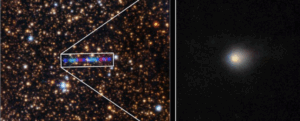
Interstellar objects are visitors from solar systems beyond our own, and the third ever such object, known as 3I/ATLAS, has just been discovered. Using the Gemini North telescope, astronomers have captured 3I/ATLAS as it makes its temporary passage through our cosmic neighborhood. These observations will help scientists study the characteristics of this rare object’s origin, orbit, and composition.
What Makes 3I/ATLAS Special?
- A giant on interstellar scales: With an estimated maximum diameter of 20 km—an enormous figure compared to ‘Oumuamua (~0.2 km) and 2I/Borisov (<1 km)—3I/ATLAS offers a singular chance for close inspection .
- Hyperbolic trajectory: Its orbital eccentricity of 6.2 (significantly greater than a parabola’s 1.0) ensures its interstellar origin and promises it won’t return.
Cosmic timing: In the middle of July, the comet is about 465 million km away from Earth (~600 million km from the Sun). It will be closest to the Sun (~210 million km) on 30 October and will roam closest to Earth (~270 million km) on 19 December without any risk.
These characteristics make 3I/ATLAS a treasure of science: a celestial ambassador from a different star, giving hints to other distant planetary systems and the constituents that build them.
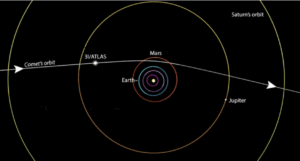
Interstellar comet 3I/ATLAS follows an open-ended, hyperbolic orbit. This view is from above the plane of the solar system and shows the comet’s position in early July. Its orbit is highly eccentric (eccentricity = 6.1) and inclined 175° to the ecliptic. Being so close to the plane of the solar system, the object will remain within a few degrees of the ecliptic for centuries to come. JPL HORIZONS with additions by Bob King
Rubin Observatory Finds Its Groove – The Great Picture
23 June 2025, NSF–DOE Vera C. Rubin Observatory showed its very first deeply stunning images—a milestone one of its 3.2-gigapixel camera, the largest ever built
Highlights from the first 10 hours of test observations:
- Took breathtaking scenes of the Trifid and Lagoon Nebulae, totaling 678 exposures in seven hours.
- 0 million galaxies, thousands of Milky Way stars, and 2,104 new asteroids found—seven near-Earth objects, none threatening.
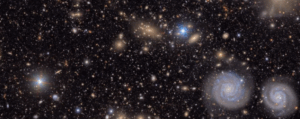
- Delivered a breathtaking cosmic tableau entitled the “Cosmic Treasure Chest,” a dramatic zoom-out from two galaxies to a cluster of galaxies.
The release means the start of the ten-year Legacy Survey of Space and Time (LSST) of Rubin, the southern sky surveyed every 3–4 nights and producing 30 TB per night, an unprecedented astronomical data treasure.

This photo pair (false color at left) from July 3rd shows 3I/ATLAS’s compact coma elongated to the west (right) in P.A. 275°. Details: 0.61-m f/6.5 reflector, CMOS camera and 91 unfiltered, stacked exposures, each 30 seconds long.
E. Guido and A. Valvasori
Why This Matters
- A Leap in Discovery
-
- Rubin’s ability to uncover tens of millions of new asteroids, comets, and interstellar objects like 3I/ATLAS in weeks, not years, redefine our capabilities to catalog Solar System travelers and protect Earth. It’s planetary defense repurposed.
- Dark Matter, Dark Energy & Cosmic Evolution
With billions of galaxies in tow, Rubin will open up the mysteries of dark matter, dark energy, and galaxy evolution, giving us a robust window into the distant Universe and its tapestry in evolution.
Gemini & Rubin: A Complementary Orchestra
Each one of them provides us with depth, breadth, and temporal information, adding depth to our quest for knowledge regarding the universe.
- Gemini North: Fast, high-resolution snapshots of evasive objects like 3I/ATLAS.
- Rubin Observatory: Continuous sky survey, unearthing new objects and weaving a broad cosmic tapestry.
What to Expect Next
Comet 3I/ATLAS will continue to be observed with ground and space-based telescopes, as scientists probe its chemistry, architecture, and interstellar origin. Meanwhile, the Vera C. Rubin Observatory is gearing up to begin its full science operations between late 2025 and early 2026, undertaking a ten-year survey of the southern sky.
Once underway, Rubin’s Legacy Survey of Space and Time (LSST) will produce gargantuan, publicly available datasets. This will enable astronomers and amateur scientists to find new cosmic objects—not just stars, black holes, and galaxies but also interstellar travelers like 3I/ATLAS—and chart the changing universe in higher resolution than ever before.
References:
NOIRLab Press Release: “Gemini North Observes Rare Interstellar Comet 3I/ATLAS”
https://noirlab.edu/public/news/noirlab2522/
NOIRLab Press Release: “Gemini North Observes Rare Interstellar Comet 3I/ATLAS”
https://noirlab.edu/public/news/noirlab2522/
Sky & Telescope: “Rare Interstellar Comet Buzzes Solar System”
https://skyandtelescope.org/astronomy-news/rare-interstellar-comet-buzzes-solar-system
Author: Lorenzo